
Last updated August 25, 2026
Free on-site gate assessment - hinges, posts, and your LiftMaster or Nice gate operator checked before anything is quoted
The assessment is free and the quote is the invoice.
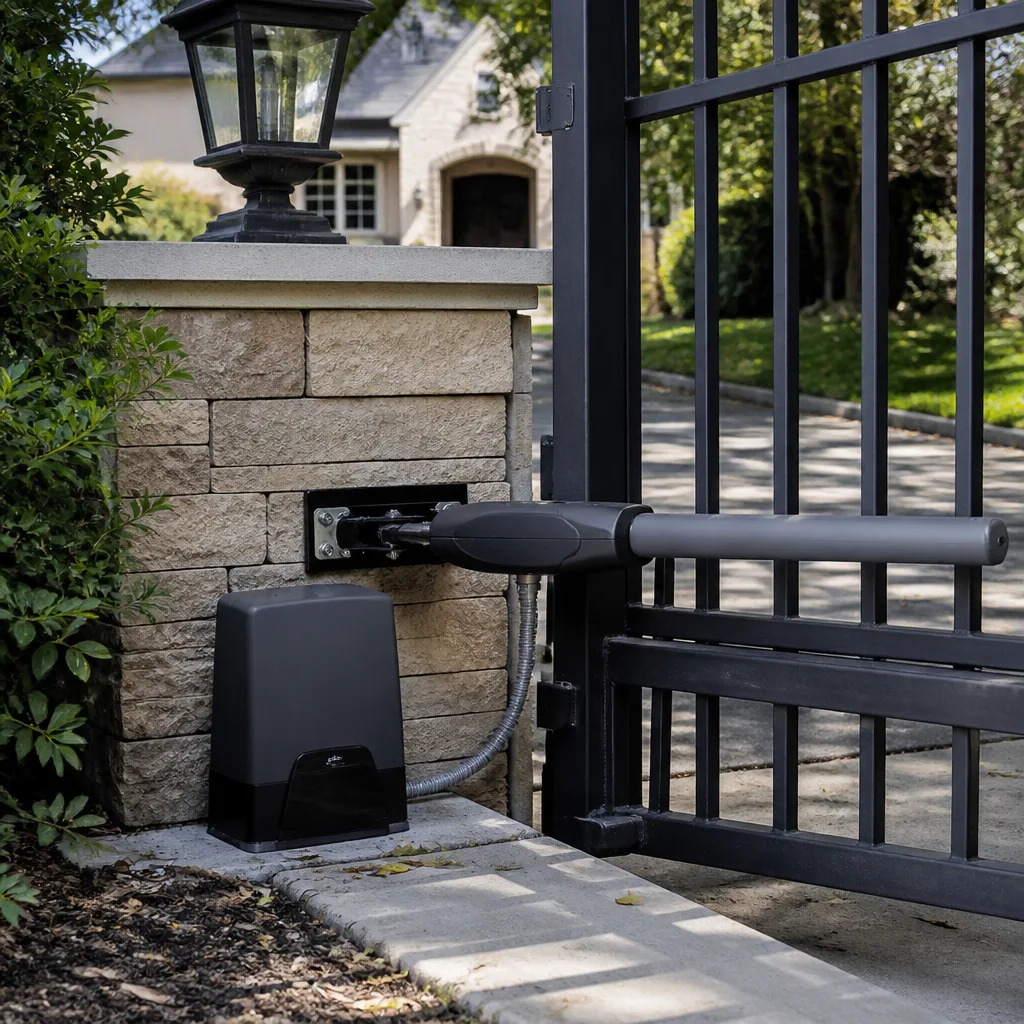
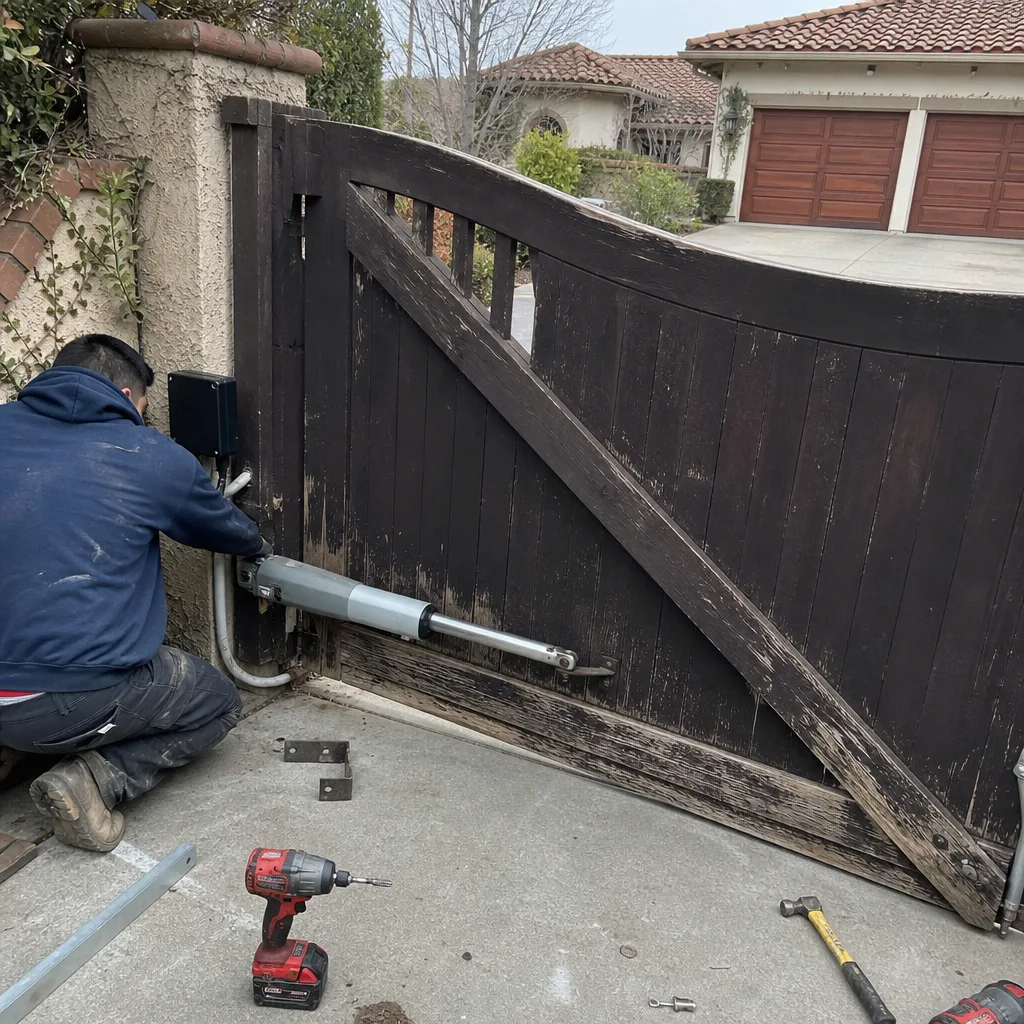 Before
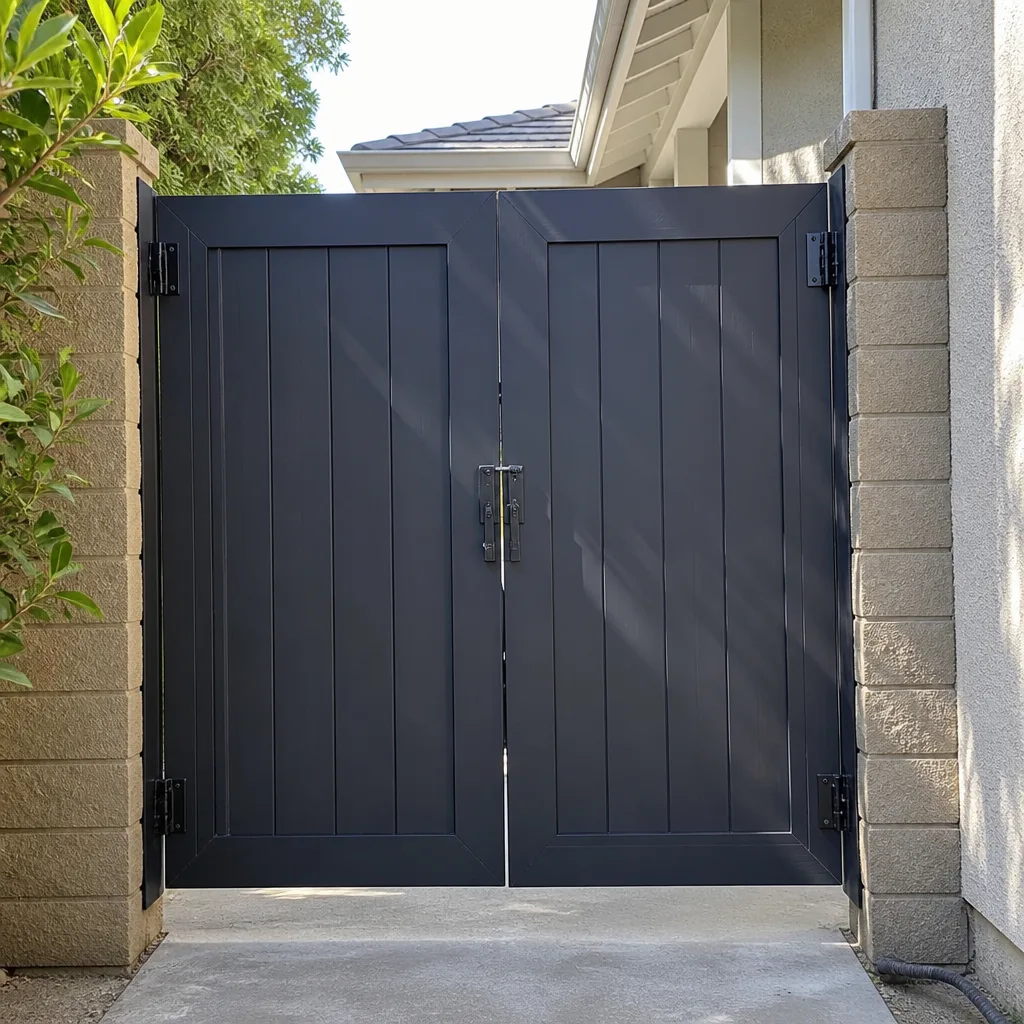 After
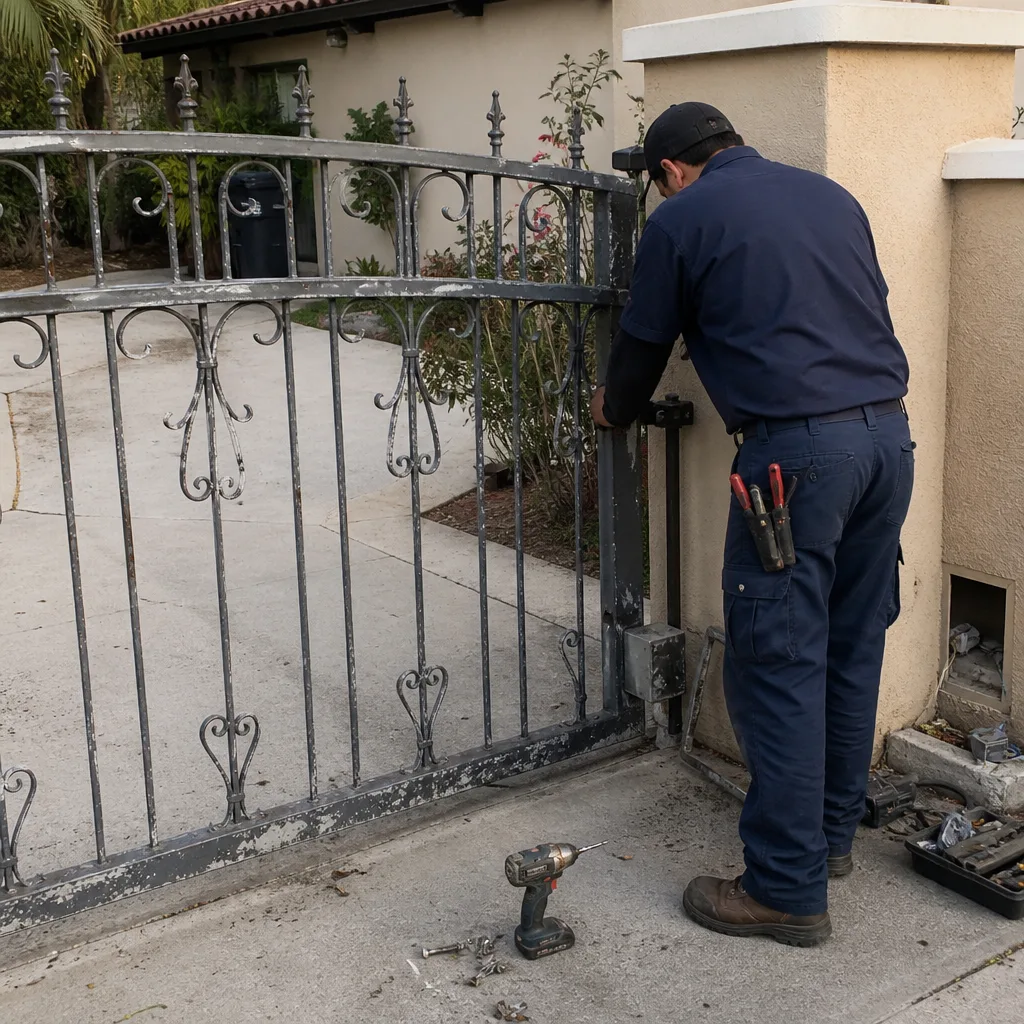 Before
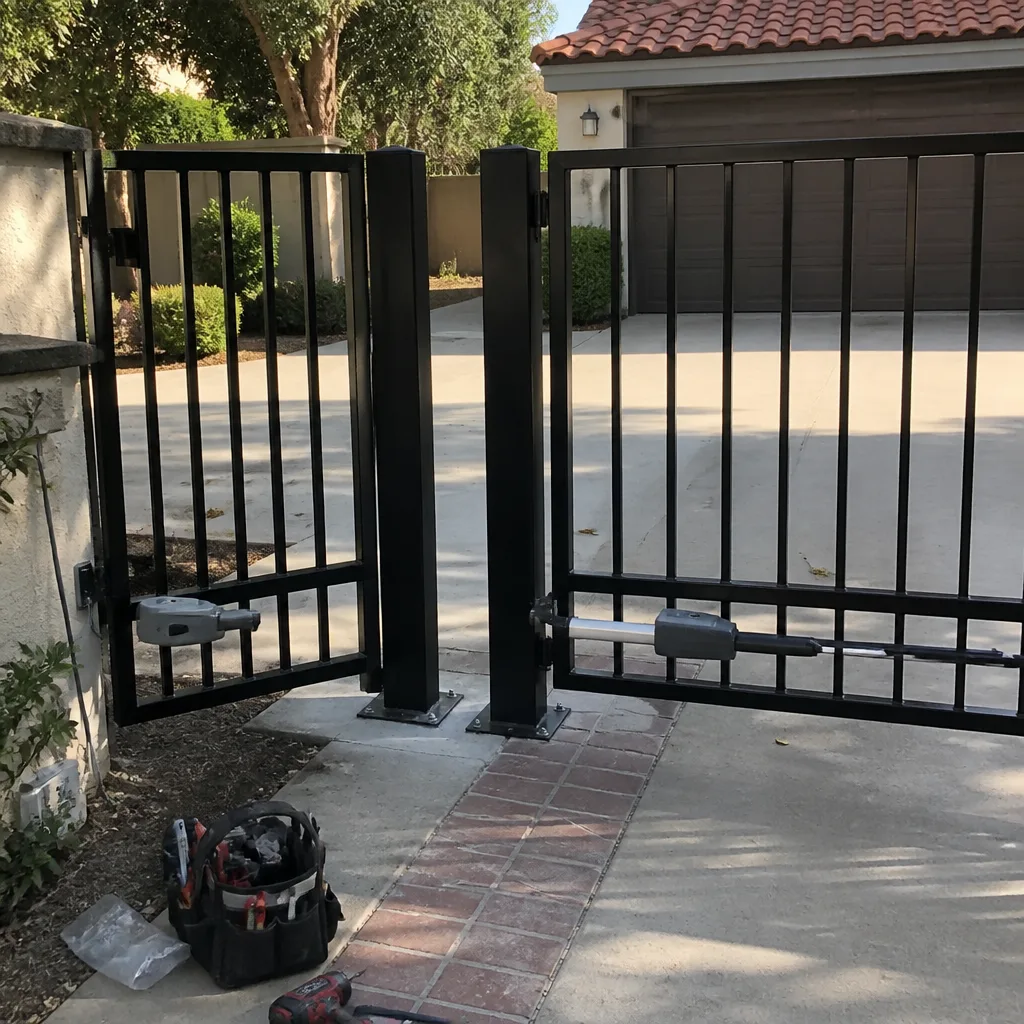 After
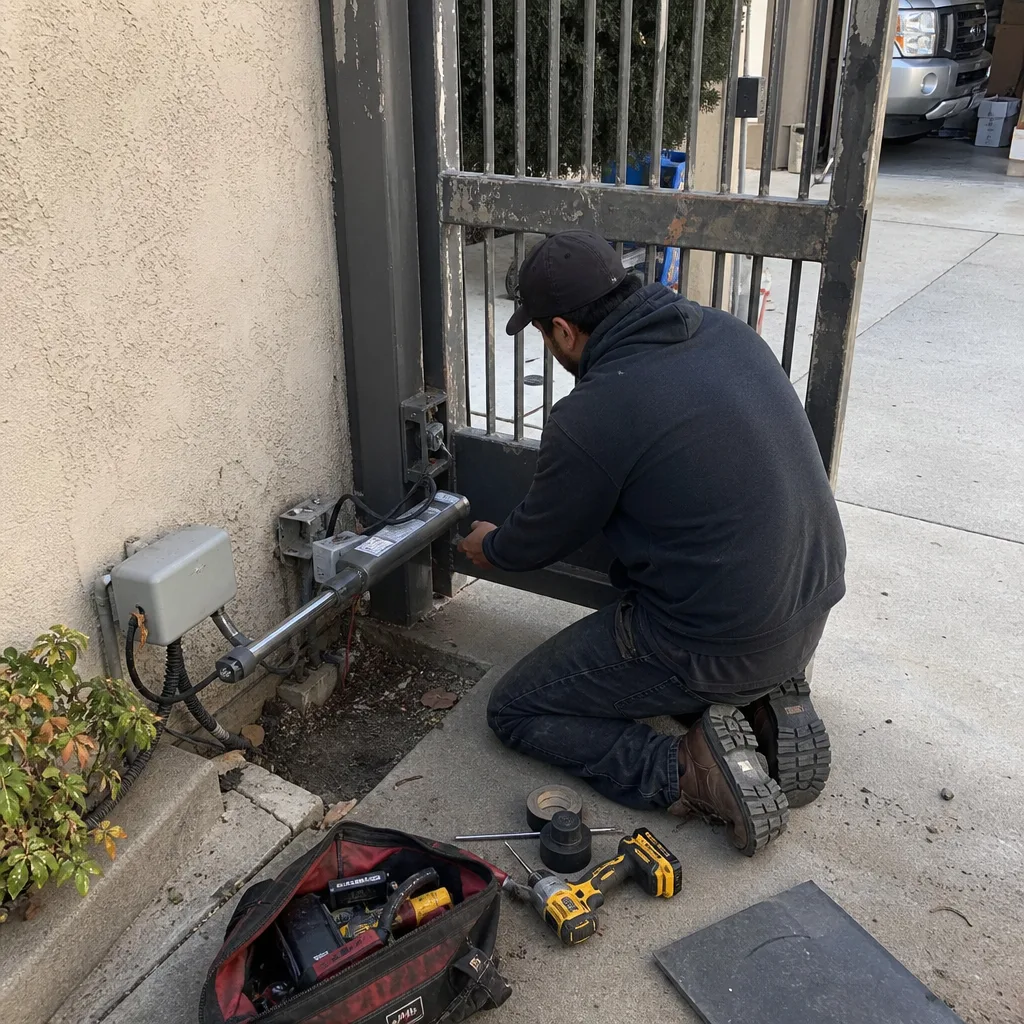 Before
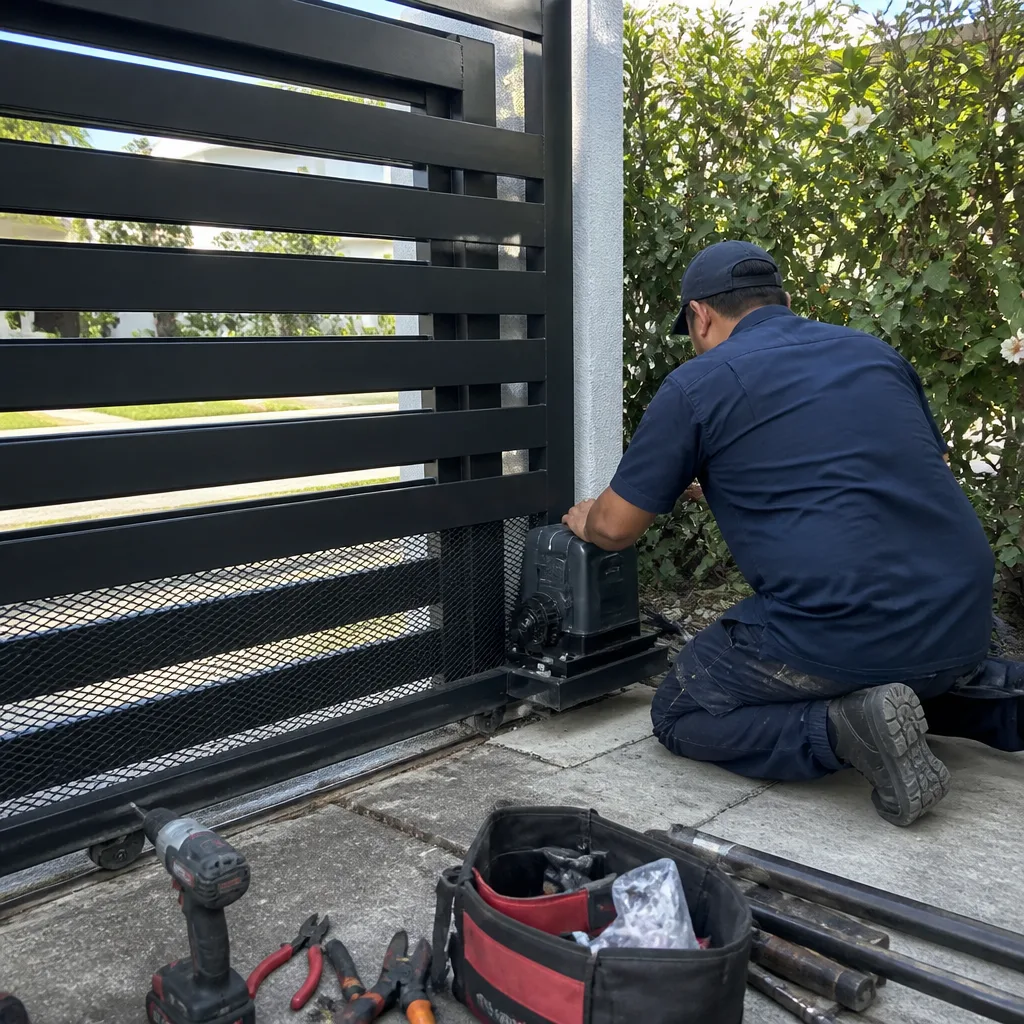 After
Seasonal Gate Repair Care for Irvine: Year-Round Homeowner’s Guide
Most Irvine homeowners don’t think about their driveway gate until the day it refuses to open. That’s a problem, because Irvine’s climate isn’t neutral on your gate. The dry heat of August, the occasional pounding rain of a winter storm, and the steady salt-tinged air rolling in from the Pacific all take their toll on hinges, motors, and circuit boards. This guide walks you through what to check, when to check it, and what to leave to a professional, season by season, so your gate keeps working for the next twenty years, not the next twenty days.
Quick Answer
Seasonal gate care in Irvine means checking hinges and bearings for wear, keeping the track and wheels clear of debris, testing the safety sensors and auto-reverse monthly, and scheduling a full inspection and lubrication twice a year, once in spring and once in fall. The two biggest seasonal threats in Irvine are winter moisture getting into electrical enclosures and summer heat causing motor thermal shutdowns. A consistent twice-yearly tune-up catches most failures before they leave you stuck in your driveway.
Table of Contents
- Why Irvine’s Climate Is Harder on Gates Than You’d Think
- Spring Maintenance: The Post-Rain Reset
- Summer Heat: Motor Strain and Metal Expansion
- Fall Preparation: Before the Rain Returns
- Winter Rain: Water, Corrosion, and Electrical Safety
- Monthly Checks Every Irvine Homeowner Should Do
- Common Mistakes to Avoid
- When to Call a Professional
- Frequently Asked Questions
- The Bottom Line
Why Irvine’s Climate Is Harder on Gates Than You’d Think
Irvine doesn’t get snow, doesn’t get hurricanes, and doesn’t get the brutal freeze-thaw cycles that crack concrete in the Midwest. So why does a driveway gate in Irvine need as much attention as one in Chicago? Because the threats are slower, quieter, and easier to ignore until the damage is done.
Three things work against your gate here. First, Irvine’s summer heat regularly pushes past 90 degrees in August and September, and your gate motor sits in a metal enclosure that turns into an oven. Motors have thermal overload protection, which is good for preventing fires and bad for getting you to work on time. When the motor overheats, it shuts down until it cools. Repeated thermal shutdowns shorten the motor’s life.
Second, the marine layer and winter storms bring moisture to a region that spends most of the year bone dry. Moisture gets into control boards, corrodes solder joints, and causes intermittent failures that are hard to diagnose. We’ve opened more than a few control boxes in Irvine neighborhoods like Northwood and Woodbridge to find circuit boards covered in green corrosion from water that seeped in months earlier.
Third, Irvine’s master-planned communities often have HOAs with strict appearance standards. Homeowners feel pressure to fix a sagging or noisy gate quickly, which sometimes leads to rushed repairs that don’t address the underlying problem. A gate that’s adjusted to look right without fixing the underlying hinge wear will be sagging again in six months.
The good news is that all three of these are manageable with a consistent seasonal routine. The bad news is that skipping a season means the next one starts with more wear, more corrosion, and more risk of a failure on the worst possible day.
Spring Maintenance: The Post-Rain Reset
Spring in Irvine is the time to undo whatever the winter rain did and prepare for the heat on the way. The ground has been wet, the air has been damp, and your gate has been working harder than at any other time of year.
Here is a spring checklist we recommend to every Irvine homeowner, following the same order we use on our $89 Seasonal Tune-Up visits:
- Inspect the track and wheels. Winter debris and rain push grit into the track. Clean it out with a dry brush and check the wheels for flat spots or wobble. A wheel that doesn’t roll true will wear the track unevenly and eventually bind.
- Check all hinge bolts for tightness. Metal expands and contracts with temperature swings, and bolts that were tight in October may have loosened by March. A loose hinge bolt on a heavy driveway gate puts shearing force on the remaining bolts every time the gate cycles.
- Test the auto-reverse and photo-eye sensors. Place an object in the gate’s path while it’s closing. The gate should stop and reverse immediately. If it doesn’t, stop using the gate in automatic mode and call a professional. This is a safety issue first and a mechanical issue second.
- Lubricate pivot points and rollers with a dry silicone spray. Avoid grease and WD-40. Grease attracts dust that turns into grinding paste, and WD-40 is a solvent that strips whatever lubrication was there. A dry silicone spray lubricates without leaving a sticky film.
- Check the battery backup system if you have one. Winter power interruptions are less common in Irvine than in other parts of the country, but the battery still ages. Most gate battery backups need replacement every two to three years.
- Look for rust spots on the gate frame and touch them up. Ocean air carries salt, and Irvine is close enough to the coast that unprotected steel picks up surface rust faster than most people expect. Sand the spot lightly, apply a rust-inhibiting primer, and finish with a matching paint.
Spring is also the best time to book the $89 Seasonal Tune-Up, before the summer heat pushes motors to their limit and before schedules fill up. We’ve found that gates serviced in March and April have measurably fewer emergency calls in July and August than gates that go into summer without attention.
Summer Heat: Motor Strain and Metal Expansion
Irvine’s summer heat is the single biggest cause of midsummer gate failures. The symptoms are consistent: the gate works fine in the morning, stops working in the afternoon, and mysteriously works again after sunset. That’s a thermal shutdown, and it means the motor is overheating.
Motors are rated for a maximum operating temperature, and the ambient heat inside a metal control box on a 95-degree Irvine afternoon can easily push past the threshold. When the motor overheats, its internal safety switch cuts power. The motor isn’t broken, but it’s telling you something: it’s working too hard, too hot, or both.
The most common causes of summer overheating are:
- Undersized motors. A heavy ornamental iron gate on a motor designed for a lighter aluminum gate will overheat every summer. The fix is a properly sized motor, not a bigger cooling fan.
- Worn hinges and bearings. Every bit of friction the motor has to overcome translates into heat. A gate that used to swing smoothly but now drags on its hinges is making the motor work harder than it was designed to.
- Incorrect limit settings. If the motor keeps pushing after the gate reaches its fully open or closed position, it’s drawing maximum current while doing no useful work. That’s heat, pure and simple.
- Debris in the track. A sliding gate that has to push through gravel or leaves on every cycle is drawing more current than it should.
What should you do on a hot day when your gate won’t move? First, give it twenty minutes in the shade. If it works after cooling down, you have a heat problem, not a dead motor. Second, make a note of the time and the outside temperature. That information helps a technician diagnose the issue faster. Third, avoid repeatedly pressing the remote while the motor is in thermal shutdown. Each press is a command the motor can’t execute, and some systems log every command in memory.
For the long term, the answer is annual maintenance that reduces friction and electrical load. A gate that moves freely doesn’t overheat. We’ve replaced motors in Irvine homes where a $50 hinge adjustment eight months earlier would have prevented a $900 motor replacement. The Keystone Standard on every job completed, the Done Right Promise, applies to motors, hinges, and everything else we touch.
Fall Preparation: Before the Rain Returns
Fall is the most important season for gate maintenance in Irvine, even though it’s the one most people skip. The weather is pleasant, the gate is working, and there’s no obvious reason to think about it. But fall is when you prepare for the rainy season, and the rainy season is when small problems become big ones.
From our experience serving Irvine, the gate failures we see in January and February almost always have their root causes in October and November. Water doesn’t break a gate overnight. It seeps into a tiny crack, corrodes a connection over weeks, and then one day the gate simply doesn’t respond.
Here is the fall preparation checklist we recommend:
- Check every seal and gasket on the control box. Rain in Irvine tends to come in short, intense bursts. A control box with a cracked or dried-out gasket will let water in during the first good storm. The fix is a $30 seal replacement, while the result of skipping it can be a $400 control board.
- Clear drainage channels around the gate posts and track. Irvine’s clay-heavy soil drains slowly, and standing water at the base of a gate post is the fastest way to rust the post from the inside. Make sure water flows away from the posts.
- Apply a fresh coat of protective wax or sealant to the gate surface. Ornamental iron gates are typically powder-coated or painted, and both finishes degrade over time. A fall touch-up protects the metal from winter moisture.
- Test the gate’s manual release. If the power goes out during a storm, you need to be able to open the gate by hand. A manual release that hasn’t been operated in years may be seized. Test it now, before you need it.
- Check the condition of the safety edges and photo-eyes. Rain and overcast conditions can affect photo-eye performance. Clean the lenses and verify that the auto-reverse functions correctly.
A fall tune-up takes about an hour for a technician and costs $89 with our Seasonal Tune-Up offer. Compare that to an emergency call on a rainy January night, when the gate won’t open and you’re late for something that matters. The math isn’t close.
We’ve worked on gates in Turtle Rock, Quail Hill, and Portola Springs, and the pattern is consistent: gates that get fall service sail through the rainy season, and gates that don’t are the ones we’re called to in the middle of a storm.
Winter Rain: Water, Corrosion, and Electrical Safety
Winter in Irvine is not a deep freeze, but it is wet enough to cause real damage. The average annual rainfall in Irvine is around 12 to 14 inches, and most of it falls between December and March. That’s not a lot compared to Seattle or Houston, but it’s enough to get into places it shouldn’t be.
The most common winter gate problems we see are:
Control board corrosion. Moisture finds its way into the control enclosure, often through a failed seal or an improperly closed door. The circuit board inside is not waterproof. Corrosion starts on the solder joints and spreads. Early symptoms include intermittent operation, unresponsive remotes, and the gate opening or closing on its own. By the time these symptoms appear, the board usually needs replacement.
Ground fault tripping. Gate motors in Irvine are required by the National Electrical Code to be on a GFCI-protected circuit. When water gets into the motor housing or a junction box, the GFCI trips and cuts power. The gate stops completely. Some homeowners respond by resetting the GFCI, and if the water has dried, the gate works again. But the moisture that caused the trip is still inside the housing, doing slow damage.
Track misalignment. Saturated soil shifts, and a concrete gate track that was perfectly level in September can settle out of level by February. A track that’s off by even a quarter inch will cause the gate to bind and strain the motor. We’ve measured more track settlement in Irvine’s newer developments than in older neighborhoods, simply because the soil in newer areas is still compacting.
Safety sensor failure. The photo-eye sensors that stop the gate when something is in the path are sensitive to moisture. When rain or fog enters the sensor housing, the sensor may malfunction and prevent the gate from closing at all. This is a designed safety behavior, but it’s frustrating when it happens at 6 a.m. in the rain.
One important safety note: never attempt to work on a gate motor’s electrical connections while the ground is wet. Gate motors operate on line voltage in most Irvine homes, and electricity plus water is a lethal combination. The circuit breaker should be off, and the area should be dry, before any electrical work is done. This is work for a trained professional with proper equipment.
If your gate fails during winter rain, the first step is to check whether the GFCI has tripped and whether water is visibly pooling near the gate posts or track. If the problem is more complex than a tripped breaker, call a professional. We answer the phone 24 hours a day, 7 days a week, with a live person on the line, including during Irvine’s rainy season when everyone else is backed up.
Monthly Checks Every Irvine Homeowner Should Do
Between seasonal tune-ups, there are five quick checks that take less than five minutes combined. You don’t need tools, and you don’t need to know how a gate motor works. You just need your eyes and your ears.
First, watch the gate cycle once from fully closed to fully open and back. Listen for any new sound: a grinding noise, a squeal, a thump, a hesitation. Gates are loud when something is wrong and quiet when everything is right. A new sound is the earliest warning sign there is.
Second, look at the track and the wheels. Is there visible debris? Has the gate started to wobble as it moves? A wobble means a wheel is loose or a bearing is wearing, and catching it now prevents a derailed gate later.
Third, test the auto-reverse with a cardboard box. Place the box in the closing path. The gate should reverse immediately and completely. Do this every month. It’s the single most important safety feature on your gate, and it’s the one that protects children and pets in Irvine neighborhoods like Woodbridge and Westpark.
Fourth, check the gate’s balance in manual mode. Release the gate from the motor and push it open by hand. It should move smoothly without catching or requiring significant force. If it’s hard to move, the motor has been compensating for a mechanical problem, and that’s costing you money in electricity and motor life.
Fifth, inspect the keypad and any intercom equipment. Do the buttons respond? Is the keypad cover still sealing out moisture? A keypad that’s fading or unresponsive is often a simple fix, but a keypad that’s been soaked by rain may need replacement.
Each of these checks takes about one minute. Done monthly, they give you early warning of small problems before they become emergency calls. We’d rather see you catch a worn bearing in February than have to replace a burned-out motor in July.
Common Mistakes to Avoid
- Using WD-40 on gate hinges and rollers. WD-40 is a solvent, not a lubricant. It strips existing grease and leaves moving parts dry. Use a dry silicone or lithium-based lubricant instead. This is the most common mistake we see in Irvine driveways, and it accelerates hinge wear every time.
- Ignoring a noisy gate. A gate that groans, squeals, or grinds is a gate that’s telling you something is wrong. The most common cause is lack of lubrication, but the second most common is a failing bearing or hinge pin. A $25 lubrication visit prevents a $300 bearing replacement.
- Overriding the auto-reverse. Some homeowners get frustrated when the gate won’t close because a sensor is misaligned, so they disable the safety system. Don’t do this. The auto-reverse exists to protect people and pets, and disabling it is a liability and a danger.
- Painting over hinges and sensors. A fresh coat of paint makes the gate look better, but paint on hinge pins causes binding, and paint on photo-eye lenses blocks the beam. Mask off moving parts and sensors before painting.
- Using a pressure washer on the control box. Pressure washers force water past seals. Keep the spray away from electrical enclosures. A garden hose set to a gentle stream is more than enough for cleaning a gate.
- Ignoring a sagging gate. A gate that scrapes the ground or no longer lines up with the latch has a structural problem, usually worn hinges or a bent post. The longer it goes unaddressed, the more damage is done to the frame and the more expensive the repair becomes.
When to Call a Professional
Some gate maintenance is in the realm of a capable homeowner: cleaning the track, testing sensors, tightening visible bolts. But there are specific situations where calling a professional is the right decision, and waiting makes things worse.
Call a professional if your gate is sagging enough to scrape the ground, because that indicates structural hinge or post failure. Call if the motor makes a humming sound but the gate doesn’t move, which typically means a failed capacitor or a seized gearbox. Call if the gate opens on its own, which suggests a control board or receiver problem. Call if you smell burning electrical insulation, which is an emergency. Call if water has visibly entered the control enclosure, because corrosion is already underway.
Ironworks Gate Co. offers free estimates in Irvine, and a technician will tell you honestly whether a repair is necessary or whether your gate has years of life left. Call (213) 566-7552 and speak with a live person. There is no pressure, no upselling, and no obligation.
Frequently Asked Questions
A full service and lubrication twice a year, in spring and fall, is the right schedule for Irvine’s climate. Between those services, monthly safety checks are a smart habit. Gates that get twice-yearly attention routinely last 15 to 20 years, while neglected gates often need major repairs by year 8 or 10. Schedule a spring tune-up before summer, call (213) 566-7552, and a fall service before the rains return.
Afternoon shutdowns in Irvine are almost always thermal overload. The motor is overheating and its safety switch is cutting power to prevent damage. The root cause is usually friction from worn hinges, an undersized motor, or incorrect limit settings. Let the gate cool for twenty minutes and call a professional for diagnosis. An $89 tune-up catches these problems early.
You can tighten visible hinge bolts, but a true sag usually means worn hinge bearings or a bent post. Fixing that requires lifting the gate off its hinges, which is dangerous work on gates that weigh hundreds of pounds. This is a job for a professional with the right equipment. We’ve repaired gates that homeowners attempted to fix themselves, and the repairs were consistently more expensive than the original fix would have been.
Ironworks Gate Co. charges $89 for a Seasonal Tune-Up in Irvine, and that includes a full inspection, lubrication, limit adjustment, safety system testing, and a written report of anything that needs attention. Estimates are free, and the price is quoted and agreed before any work starts. Call (213) 566-7552 to schedule.
First, check the GFCI outlet or breaker that powers the gate. Rain often trips the GFCI, and resetting it may restore power. If the gate still doesn’t respond, it’s likely that moisture has intruded into the control board or a sensor housing. Do not attempt to dry out the electronics yourself. Call a professional for a diagnosis. A live person answers our phone at (213) 566-7552, any hour.
Yes. We service and repair nine major gate opener brands, including FAAC, BFT, Linear, and Viking, along with LiftMaster, Ghost Controls, DoorKing, Elite, and Mighty Mule. Whatever opener is on your Irvine driveway, we’re trained and equipped to make the correct fix on the first visit. If you’re not sure what brand you have, call and we’ll help you identify it.
With proper seasonal maintenance, a quality gate opener in Irvine lasts 10 to 15 years. Without maintenance, the same opener may fail in 5 to 7 years. The difference is friction, heat, and moisture management. Twice-yearly tune-ups are the cheapest insurance you can buy for your gate system.
The Bottom Line
Your gate is a machine, and machines need maintenance. Irvine’s climate won’t freeze it solid or blow it over, but heat and moisture will age it quietly, year after year, until one day it stops when you need it most. The solution is simple: five minute monthly checks, a spring tune-up before the heat, a fall tune-up before the rain, and a professional call the moment something changes. It’s not the most exciting part of homeownership, but it’s one of the most cost-effective. Done right, and backed in writing, your gate will be closing like new for decades.
Ready to schedule your seasonal tune-up or get a free estimate? Call Ironworks Gate Co. at (213) 566-7552. A live person answers 24 hours a day, and our $89 Seasonal Tune-Up is the best value in Irvine. Explore our Ironworks Gate Co. home services, or ask about our Free Second Opinion on any written estimate you’ve received.
Written by the team at Ironworks Gate Co.